One sentence
An independent research director who finds structural openings and directs AI-assisted investigation until an idea becomes a working object, a finished result, or a useful failure.
An independent research director who finds structural openings and directs AI-assisted investigation until an idea becomes a working object, a finished result, or a useful failure.
Joshuah Rainstar is an Iowa-based independent research director with a B.S. in computer science and later study in watershed management and social hydrology. Raised in the southern High Plains of Kansas, he works as an unusually broad investigator across computing, imaging, mathematics, radios, physical systems, governance, and whatever else refuses to remain in its assigned category.
Rainstar revisited a real-arithmetic Fourier transform largely left behind after the nineteen-seventies. His AI-assisted research program traced its numerical weakness to its coordinate system, rebuilt it as working software, and extended the recovered geometry into alternate dataflows and physical-computation designs.
A long-running imaging program turned an operation usually associated with offline mathematical processing into a native live-video effect. The work links algorithm diagnosis, exact reconstruction, performance engineering, and an OBS implementation.
Rainstar's image research grew from decomposition into a topology-aware vectorizer. Rather than merely tracing edges, it constructs a structural explanation of the raster and then converts that explanation into editable SVG under an explicit error budget.
The local image optimizer applies ideas developed in Rainstar's decomposition and vectorization work to ordinary JPEG encoding. It searches over standards-compatible output while judging both the actual file and the image that users will decode.
Rainstar's largest ongoing project began as a file manager and expanded into a local intelligence stack. It combines retrieval, capability control, native interface work, and an unusually explicit system for recording why architectural decisions were accepted or rejected.
Working with frontier coding models, Rainstar replaced a maze of local determinant checks with a global transport proof. The project determines the exact finite total-positivity order of the Riemann kernel and packages the result as a Lean-checked, DOI-backed release.
Rainstar designed a context-conditioned language-model decoder whose backward vocabulary subspace changes orientation with the hidden state. The project aims at the gradient bottleneck beneath the output head, not simply at increasing the apparent rank of generated probabilities.
Rainstar's attempt to replace an ordinary learned linear map produced a much more capable structural operator but did not solve the extrapolation problem that motivated it. A dedicated spiral experiment showed the distinction between fitting difficult observed geometry and learning the law that generates its continuation.
Rainstar works as the director of an investigator-led, AI-assisted research practice. He chooses the questions, supplies the structural intuition, defines the rules of evidence, redirects failed approaches, and maintains continuity across long programs. Coding models contribute substantial mathematics, engineering, and analysis.
The transparent PNG is the website's rotoscoped resident identity. Credit: Joshuah Rainstar / paymenottowork.com.
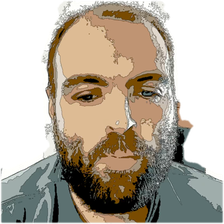
224 × 224 PNG, transparent background, derived from the resident's immutable source video.