Glory first be to The Holy One, Blessed be He (הַקָּדוֹשׁ בָּרוּךְ הוּא), from whom all good things come. To Him we attribute the ability that has provided for all good to come and be demonstrated anywhere herein, and declare ourselves unworthy servants. If in any way we have erred, or our work is insufficient, we ask mercy and kindness, for our effort is good and earnest.
GIVE ME MONEY
If I don't work for you, that's one thing. If you make sure I don't work for someone else, what happens?
You can use them. Nobody can make them private again.
-
PlaySuiteA reference application for GUI.Forms: a retained-state game framework with its own engines

PlaySuite is a freeware reference application for GUI.Forms: one highly efficient native suite of individually interactive microprograms for Windows, Mac and Linux, built on a retained control tree, that opens on a walnut shelf of individually packaged games and curios. Behind the shelf is a framework with carefully hand-developed engines useful for game development and content representation. Each game is a folder, so adding one is easy.
-
BFFTBruun's real Fourier transform, made exact and well conditioned
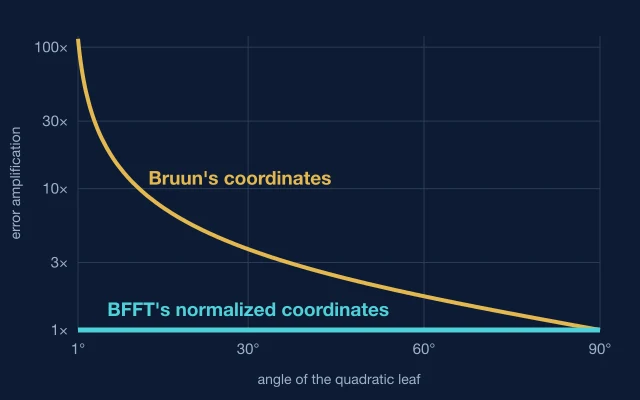
In 1978 G. Bruun factored the real Fourier transform using real coefficients alone, and the method was set aside as numerically unreliable. The trouble was the coordinate each stage worked in. Rewritten in a normalized frame, every stage is a rotation followed by a sum-and-difference merge, the whole transform has condition number one, and it equals the DFT up to a stated reordering. BFFT is a MIT-licensed, SIMD-optimized C and C++ library built on that proof, with Python bindings. It is also a repository where a physically realizable fourier transform may be found, and where other experiments that utilize fourier transforms have been realized.
-
CONVA new kind of interpolation: nonlinear, conservative and exactly reversible
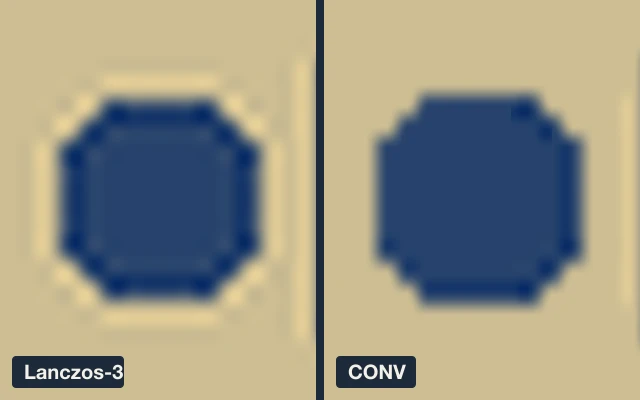
CONV is a new way to rebuild an image between its pixels: the first genuinely new interpolator of its class since Lanczos's windowed sinc and its extension to arbitrary transforms, the elliptical Jinc-windowed filter that the perspective workbench compares it against. Those kernels are linear, applying the same weights whatever the picture holds, and that is why sharp ones ring. CONV is nonlinear: it reads which rises and falls the pixels actually contain and lets the curve make only those turns, while keeping every original value and every cell's total. The result is one continuous picture of the image. Resizing to any size, rotating, skewing and correcting perspective are all readings of it, and its multiresolution form returns the original exactly. It still compiles into ordinary convolution banks, and it already does the transforms in Plan Paint.
-
Plan PaintThe Paint you misremember, for Windows, Mac and Linux

Plan Paint is the Paint you misremember since it should have existed. It has the Windows 7 ribbon and runs on Mac, Windows and Linux in a download under 30 MB. Beneath the ribbon are brushes with real tooth and grain, Bézier paths and stencils, a working Spirograph, gradients, and a color picker whose cells are sized by how differently the eye sees them. It is free, MIT licensed, speaks 22 languages and is a reference application for GUI.Forms.
-
PortsmouthAn equal-weight midpoint synthesis of five fonts
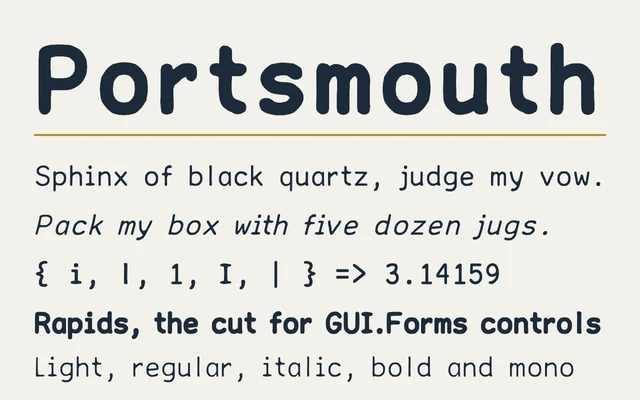
Portsmouth is an equal-weight midpoint synthesis of five fonts selected for their organic and simple nature: a terminal, teletext, a comic hand and a lettering template contribute to a smooth and generic font that one could find anywhere. A monospaced font gives every letter an equal box; Portsmouth additionally sets every letter the same distance from its neighbors, measured ink to ink, with no kerning table and no optical fitting, and the rhythm comes out even, allowing even non-monospaced fonts a standard cadence. Principled decisions for key letters eliminate confusion; this font is ready for your console.
-
GUI.FormsThe cross-platform retained-mode toolkit the desktop has been missing
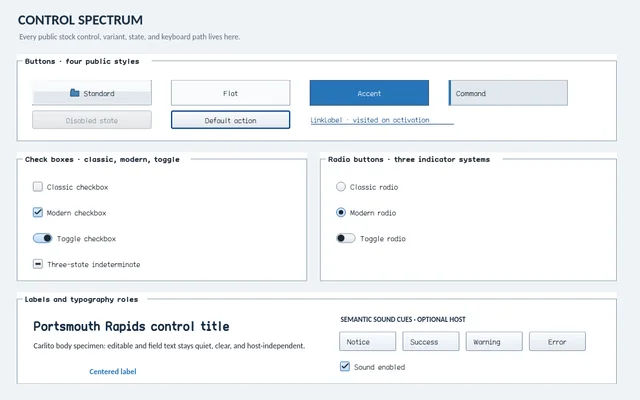
Much of the desktop now runs inside a web browser: Electron applications, each shipping its own copy of Chrome. The alternatives are immediate-mode toolkits like Dear ImGui or older wrappers like wxWidgets, because there has never been a good cross-platform retained-mode toolkit that is easy to use. GUI.Forms is that toolkit, at its beginning. It reproduces and extends the Windows Forms API, so a control tree is built once and changed in code. Beneath that, it works out what a foundation library needs, the same way on macOS, Windows and Linux: its own event loop, direct rendering with live handling of frame-buffer contents and updates, and one FreeType text engine that draws the same glyphs everywhere. It is as principled as Telerik or Xamarin were, and it is open source. Plan Paint and PlaySuite are built on it. What its author sells is the taste and direction behind it, by the hour.
-
FlowCellsSegments any image on the CPU: few cells, high fidelity, no training
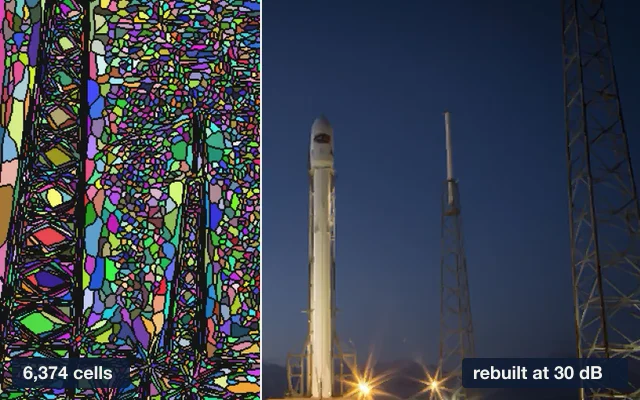
FlowCells segments images. Given any picture, it divides it into connected cells that follow its shapes and texture, crowding where detail is dense and stretching along edges. It runs on the CPU, needs no training, and takes a couple of seconds. The cells prove themselves by rebuilding the picture: on the standard rocket photograph, 6,374 of them, each with its own small color model, reproduce the frame at 30 dB. Few segments, high fidelity and no GPU make it competitive with the state of the art, and there is little else like it.
-
Entropic HDRThe optimal camera filter, worked out by entropy, live in OBS today
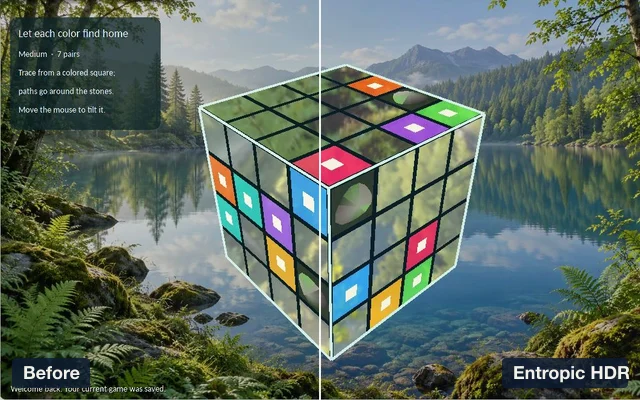
Entropic HDR is an algorithm that acts like the optimal filter for a camera. It measures entropy across the frame to find where the real information is, then redistributes what the picture has to spend, in color, brightness and contrast, toward it. Dim texture opens up, faint color comes forward, and the result looks like a perfectly profiled HDR picture. It follows the scene as it changes, correcting each moment with nothing to dial in. Today it runs live as an OBS plugin; the same method could sit inside a camera.
-
PF4The exact Pólya frequency order of the Riemann kernel, sealed
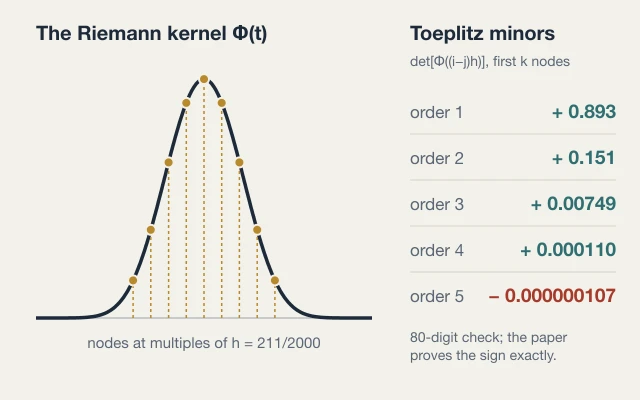
PF4 settles one property of the kernel behind Riemann's zeta function for good: its exact Pólya frequency order is four. Every determinant of its translates through order four is strictly positive, for every arrangement of points, and order five fails. Its author designed and drove the work over several months with AI agents. Every time the work produced a numerical bound, the author insisted that an exact integral could replace it, and it could, until the proof left nowhere for a counterexample to hide. Nothing in it rests on a citation: every result it uses is proved inside the paper, and the final theorem is checked in Lean 4 against only the standard axioms. It is a demonstration of what sustained intuition and discipline can extract.
If there's only so much market, everything I could do in it represents a potential cost to you.




















— visitors recorded. Leave a comment